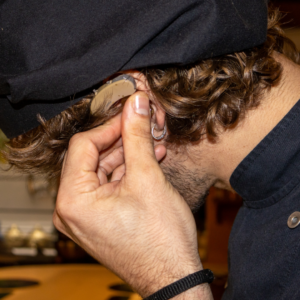

It is incredibly common for individuals to resist getting hearing instruments simply because they dread a bulky appearance or an uncomfortable fit. This hesitation is entirely valid given historical product designs! Furthermore, many individuals harbored deep anxieties about social isolation, fearing others would exclude them from discussions based on assumptions of cognitive decline or profound auditory deficits.
For many people, this image has stuck, making them hesitant to take the next step. However, contemporary medical engineering has ensured that current hearing solutions look and function in a completely unexpected manner. Thanks to rapid technological evolution, modern devices are remarkably downsized, highly ergonomic, and exceptionally covert.
If cosmetic anxiety has caused you to delay treating your hearing loss, it is highly recommended that you evaluate the sophisticated options now available.
Why the Bulky, Obvious Hearing Aid Is a Thing of the Past
If you close your eyes and picture a hearing aid, you might imagine something large, hooked over the ear, and visible from across the room. If that description matches your mental model, your perceptions are anchored in the primitive analog technology of the late twentieth century.
Since that era, the manufacturing landscape for hearing solutions has completely transformed. Continuous refinements in ergonomic styling, nanometer-scale circuitry, and digital audio engineering have radically overhauled the modern cosmetic profile. Today’s instruments are profoundly smaller, remarkably streamlined, and strategically engineered to blend flawlessly into your natural anatomy or vanish altogether.
A substantial percentage of contemporary options reside deep within the auditory canal, ensuring absolute invisibility during routine face-to-face interactions. Alternative styles occupy a tiny footprint behind the pinna, utilizing ultra-light materials and customizable color palettes to match hair or skin tones perfectly.
A Taxonomy of Modern Styles: From Totally Hidden to Ultra-Streamlined
To understand how these sophisticated medical devices are physically configured, review this concise anatomical breakdown:
Invisible-in-canal (IIC)
This specific configuration offers the highest degree of user discretion. IIC devices sit completely inside the ear canal and are custom-made to fit your ear. When engaging with others at standard social distances, these units are utterly unnoticeable to the naked eye. This configuration is highly favored by individuals managing mild-to-moderate auditory drops who demand total aesthetic secrecy.
The Versatile Receiver-in-Canal (RIC) / Receiver-in-the-Ear (RITE) Style
This particular layout has become the benchmark standard for contemporary hearing health restoration. A tiny component sits behind the ear, connected by a nearly invisible wire to a small speaker in the ear canal. To onlookers, this streamlined design closely mirrors fashionable consumer electronics or sports earbuds. Unless an individual is specifically searching for the device, it remains completely unnoticed during normal interactions.
Behind-the-ear (BTE)
While these models house all electronic components within a casing resting behind the pinna, their dimensions are drastically reduced compared to legacy models. They’re often recommended for more significant hearing loss and offer excellent performance without the bulky appearance people expect.
The bottom line is simple: modern assistive hearing systems are crafted to serve your life quietly, not to draw attention to your ears.
Advanced Features: Beyond Aesthetics to Smart Technology Integration
The changes in modern hearing aids aren’t just cosmetic. Contemporary devices are essentially miniature smart hubs rather than historical medical hardware. A vast majority feature native Bluetooth connectivity, enabling seamless, wireless streaming of telephonic communication, media, and television audio directly into your auditory pathway.
Through proprietary mobile apps, patients can effortlessly adjust acoustic thresholds or modify directional settings completely hands-free. For instance, when entering a highly reverberant dining space, you can suppress ambient acoustic noise and sharpen speech clarity in mere moments. Convenient overnight charging systems have permanently replaced the tiny disposable batteries that patients traditionally struggled to replace. Just place them on a charger overnight, like your phone.
Empowerment Over Hesitation: Redefining Hearing Health Care
Even knowing all of this, it’s easy to hesitate. Scheduling an appointment can feel like a profound internal challenge because it represents an open admission of sensory alteration. This can make us feel helpless and like we aren’t fully in control of what’s happening to our bodies.
Let’s reframe this narrative completely: acquiring a modern acoustic instrument is not an admission of weakness. They are merely an intelligent adaptation to a universal milestone of aging that impacts us all eventually. They’re proof that you’re taking action to support and equip your body in essential ways.
Picture yourself wearing an ultra-low-profile, virtually invisible instrument that allows you to effortlessly decode rapid speech, thrive in complex soundscapes, and re-engage with your favorite hobbies. That level of sensory restoration is incredibly liberating!
See For Yourself What Today’s Hearing Aids Look Like
To dismantle old assumptions, the best strategy is to witness these design breakthroughs with your own eyes. We warmly welcome you to tour our practice, consult with our audiologists, and review our product lines with absolutely no financial or purchase obligations. View this consultation simply as a tactile opportunity to discover just how radically changed this technology has truly become.
You will likely be utterly delighted to discover how microscopic, physically seamless, and high-performing today’s options truly are! Call our office to schedule your visit online today.